Evergreen Privacy Trees for Tennessee Homes
Published by MRX Landscaping · Last updated: September 6, 2026
Editorial guidance for Middle Tennessee homeowners from MRX Landscaping. Not a substitute for an on-site estimate.
What evergreen trees in Tennessee work for privacy screening?
There is no single evergreen privacy tree for every Tennessee lot. Common year-round screen options include arborvitae, Green Giant arborvitae, Leyland cypress, and Eastern red cedar—when available width, desired height, sunlight, spacing, maintenance, and soil moisture match the site. Spacing for mature width matters more than instant coverage, and faster early growth is only useful when the tree has room to mature without crowding fences, windows, or utilities. Use the privacy trees guide for selection research; request an install estimate when you are ready to plant.
There is no single evergreen privacy tree that fits every Tennessee home. When homeowners look for evergreen trees in Tennessee for screening, they usually want year-round cover—but sun, soil moisture, available width, target height, and maintenance still decide which plant belongs on the lot.
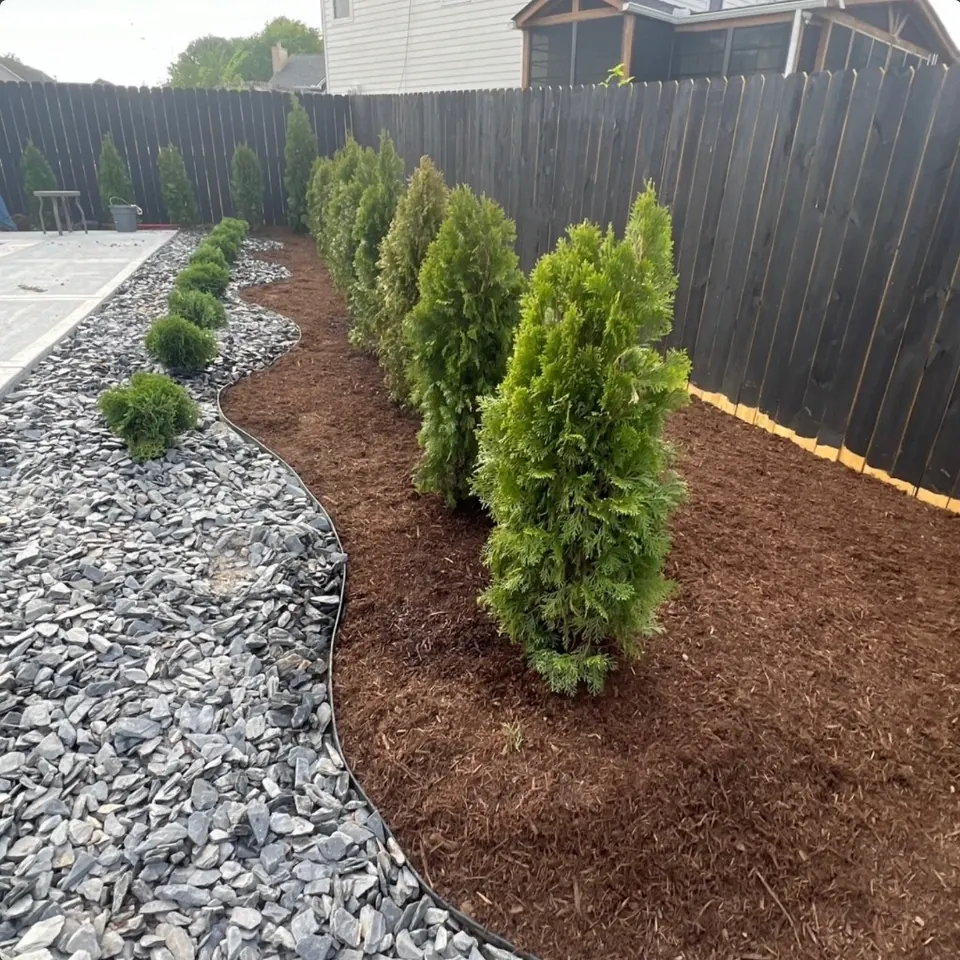
MRX Landscaping plans privacy trees through privacy tree installation—and often coordinates surrounding plant installation—so spacing, mature size, and bed prep are considered before the first tree goes in the ground. A verified Spring Hill landscape bed and privacy planting shows how an evergreen fence-line screen can finish with mulch. Homeowners comparing denser lower screening may also find our privacy shrubs guide useful.
Evergreen Trees in Tennessee for Year-Round Privacy
Searches for evergreen trees in Tennessee often mix two needs: plants that stay green in winter, and plants tall enough to block a neighbor, road, or patio view. Deciduous trees can soften a property line in summer, but they drop leaves and reopen sight lines in winter. Healthy evergreen privacy trees keep foliage year-round, which is why they dominate Tennessee screening plans.
That does not mean every evergreen belongs on every Middle Tennessee lot. Clay soil, summer heat, ice, bed width, and sun exposure still filter whether arborvitae, Green Giant arborvitae, Leyland cypress, Eastern red cedar, or another option is realistic. Use the comparison below for plant-level tradeoffs, then confirm spacing and install scope on a site visit—not from a nursery label alone.
Common Evergreen Privacy Trees for Tennessee Yards
The trees below are commonly considered for evergreen privacy screening in Tennessee. They stay green year-round when healthy, but site fit still matters more than the label “evergreen.”
Arborvitae
Standard arborvitae is often used for evergreen screening where a narrower vertical form fits the bed. Performance depends on sun, consistent moisture during establishment, and enough room so lower foliage is not crowded against fences or walls.
Green Giant arborvitae
Green Giant arborvitae is popular for taller evergreen screens because it can grow quickly when conditions are favorable. It still needs spacing for mature width, good drainage, and a plan for height as the screen fills in. It is a strong option in many Middle Tennessee yards, not a universal answer for every lot.
Leyland cypress
Leyland cypress can create a fast evergreen screen, but tight spacing and limited airflow often lead to long-term maintenance issues. It should only be planted where there is room for mature size and where soil and drainage support healthy growth.
Eastern red cedar
Eastern red cedar is a native evergreen that can work for privacy in sunnier, tougher sites once established. It has a different form and texture than formal arborvitae screens, so it fits better in naturalistic or mixed plantings than in a perfectly clipped hedge look.
Fast-Growing Evergreen Screens: Tradeoffs
Homeowners often look for faster-growing evergreen privacy trees. Green Giant arborvitae and Leyland cypress are frequently compared for quicker early coverage, but growth speed is only useful when the planting has room for mature height and width.
Faster early fill-in can come with tradeoffs: tighter rows reduce airflow, crowded trees thin at the base, and plants that outgrow a narrow corridor create heavier pruning later. Spacing for mature width, screening density goals, and long-term maintenance usually matter more than choosing the “fastest” label alone.
Spacing, Growth Rates, and Screening Goals
Space privacy trees for mature width, not the first year of coverage. Crowding trees for instant privacy can reduce airflow, thin lower branches, and force heavier pruning later. Staggered rows or a wider bed often look better and stay healthier than a single jammed line.
Growth rate varies with plant choice, sun exposure, soil, watering during establishment, and first-year care. Fast growth is useful only when the tree has room to mature without blocking windows, utilities, driveways, or fence access.
Maintenance Expectations
Even evergreen privacy trees need attention. Expect watering during establishment, mulch kept off trunks, occasional inspection for stress or disease, and selective pruning for clearance or shape. Formal screens usually need more shaping than naturalistic plantings.
If you want denser lower screening without tall tree height, layered planting with shrubs can complement a privacy tree row. Match the maintenance plan to the plant before installation so the screen stays manageable.
Choosing for Middle Tennessee Properties
Franklin and Brentwood lots with mature canopy may need shade-aware screening and careful root-zone planning. Newer Spring Hill or Thompson's Station yards may have more open sun but still need width for a tall evergreen row. Property lines, HOA rules, and underground utilities should be checked before planting.
A site walk in the communities we serve—Spring Hill, Franklin, Brentwood, and nearby Middle Tennessee towns—helps compare options against the actual view you want to block, the soil you have, and the width available. That is how privacy planting stays functional instead of becoming an overcrowded hedge.
When you are ready for installation help, start with privacy tree installation. Surrounding plant installation—especially plant installation in Spring Hill, where a verified privacy planting project is published—can support layered beds beside the screen. For Franklin properties, see plant installation in Franklin; for Brentwood, see plant installation in Brentwood. Review the Spring Hill landscape bed and privacy planting, then request a privacy tree installation estimate for your property.
Evergreen privacy tree options commonly compared for Tennessee yards
| Factor | Best use | Growth characteristics | Spacing considerations | Important caveat |
|---|---|---|---|---|
| Arborvitae | Narrower evergreen screens along fences or foundation edges | Upright form; fill-in depends on sun and consistent moisture | Space for mature width—not nursery pot size | Crowding against fences or walls thins lower foliage over time |
| Green Giant arborvitae | Taller evergreen screens where height and faster fill-in are priorities | Can grow quickly when sun, moisture, and soil are favorable | Needs room for mature height and width as the screen fills | Strong option in many Middle Tennessee yards—not universal for every lot |
| Leyland cypress | Fast evergreen screens on sites with enough room and airflow | Often chosen for rapid early coverage | Requires mature-size spacing; tight rows raise long-term risk | Limited airflow and tight spacing often create maintenance issues later |
| Eastern red cedar | Sunnier, tougher sites and naturalistic mixed plantings | Native evergreen with a different form than formal arborvitae hedges | Plan for mature canopy and site exposure rather than a clipped hedge look | Better for naturalistic screens than a perfectly uniform formal hedge |
Related Next Steps
When you are ready to move from species research to installation, start with privacy tree installation. Surrounding beds can be scoped through plant installation in Spring Hill, plant installation in Franklin, or plant installation in Brentwood. Review the Spring Hill landscape bed and privacy planting below, then request a privacy tree installation estimate for a site visit.