Concrete vs Block Retaining Walls in Tennessee
Published by MRX Landscaping · Last updated: August 7, 2026
Editorial guidance for Middle Tennessee homeowners from MRX Landscaping. Not a substitute for an on-site estimate.
Concrete vs block retaining walls—how do they compare?
Segmental block walls are common for residential landscape masonry with texture, caps, and curves. Poured concrete creates a continuous structural face. Both need drainage stone, outlets, and proper base prep; longevity depends on installation quality and water management in Tennessee clay soil.
Choosing between poured concrete and segmental block retaining walls in Tennessee is an educational comparison—not a verdict that one material always wins. Appearance, drainage, base prep, and how the wall meets beds or hardscape usually matter more than a generic durability claim.
MRX Landscaping builds residential retaining walls using block, stone, and boulder options depending on site conditions; material choice is confirmed during an estimate. For installation scope and pricing, use the retaining walls service page rather than treating this guide as a quote.
Appearance
Segmental block walls usually read as finished landscape masonry, with texture, color options, caps, curves, and steps that blend into planting beds. Poured concrete offers a continuous, monolithic face that can look cleaner in more structural or modern settings, though surface finishes vary by design.
Durability and Long-Term Performance
Either system can perform for a long time when installed correctly. Durability tracks base prep, reinforcement or geogrid where required, backfill, and drainage more than marketing claims about the wall face. For typical service-life factors, see how long retaining walls last in Tennessee conditions.
Cost Drivers
Cost depends on height, length, excavation, access, drainage, engineering needs, and finish details. Block walls can be efficient for many residential layouts; poured concrete can cost more when forming, reinforcement, delivery, and curing add complexity. Online square-foot averages rarely capture backyard access or clay excavation.
Drainage and Installation Complexity
Both wall types need drainage stone, a path for water to exit, and finish grading that keeps runoff from collecting behind the face. Block installation centers on compacted aggregate, level courses, and correct setback. Concrete installation adds forming, steel, pour logistics, and cure time before backfill.
On residential retaining walls projects, those construction steps should be coordinated with surrounding hardscaping so steps, patio edges, and bed grades do not fight the wall’s drainage plan.
Slope and Site Planning
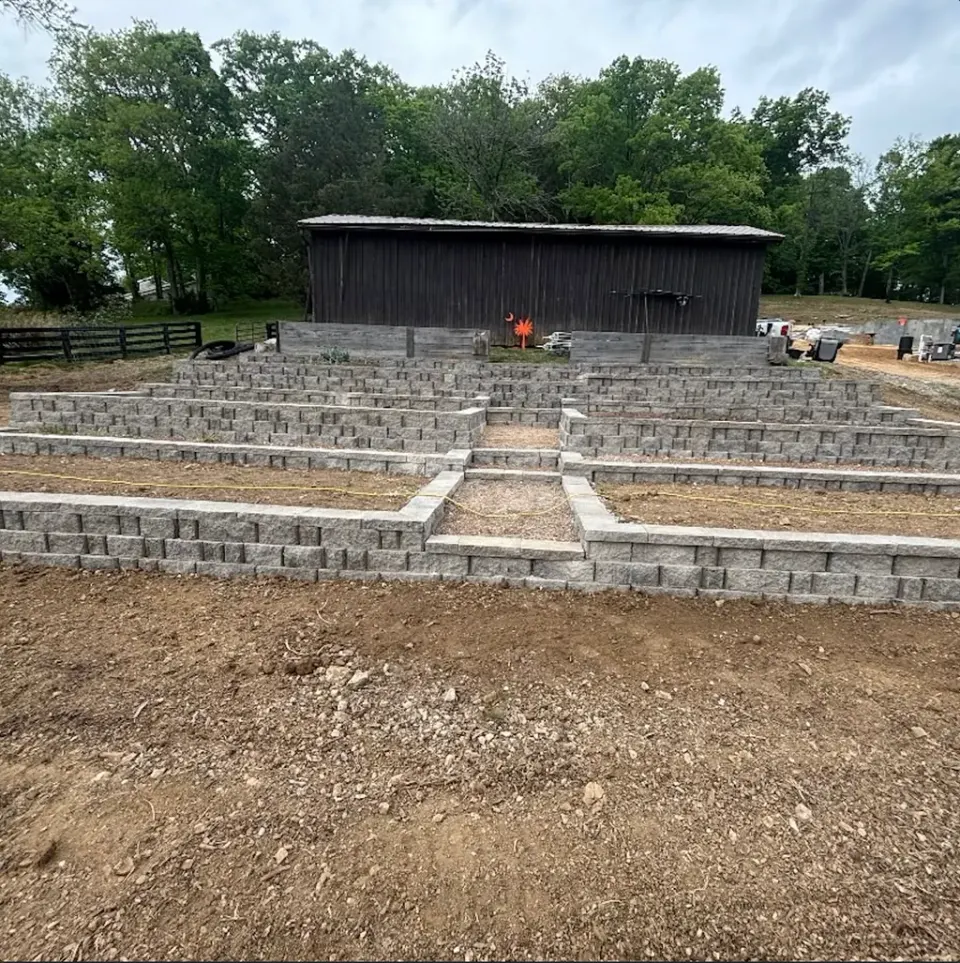
Steeper slopes increase retained soil load, excavation depth, and drainage requirements for either wall type. Terraced layouts—like the Franklin Biscayne yard makeover—can break a long slope into manageable wall sections when grade and access allow.
Wall height, setback from property lines, and connection to patio or walk grades should be planned before material selection so the finished yard drains correctly.
Long-Term Maintenance
Block walls may allow more localized unit work when damage is limited, while concrete repairs can be harder to blend visually. In either case, clear outlets and watch for early movement. Homeowners planning retaining walls in Brentwood should pair material choice with site access, slope, and water management—not appearance alone.
Poured concrete vs segmental block retaining walls
| Factor | Segmental block | Poured concrete |
|---|---|---|
| Typical appearance | Textured masonry with caps and curves | Continuous monolithic face |
| Drainage needs | Drainage aggregate and outlets required | Drainage and relief paths required |
| Repairs | Localized unit work possible in some cases | Visual blending can be harder across large cracks |
| Cost drivers | Height, access, excavation, curves, caps | Forming, steel, pour logistics, cure time, height |
Related Next Steps
If you are comparing systems, start with retaining wall installation in Franklin, Brentwood retaining wall contractors, retaining wall lifespan factors, and the terraced wall project.